Petros Stefaneas
Professor of Logic and Philosophy of Computer Science at the National Technical University of Athens. Member of the Institute’s Scientific Council.
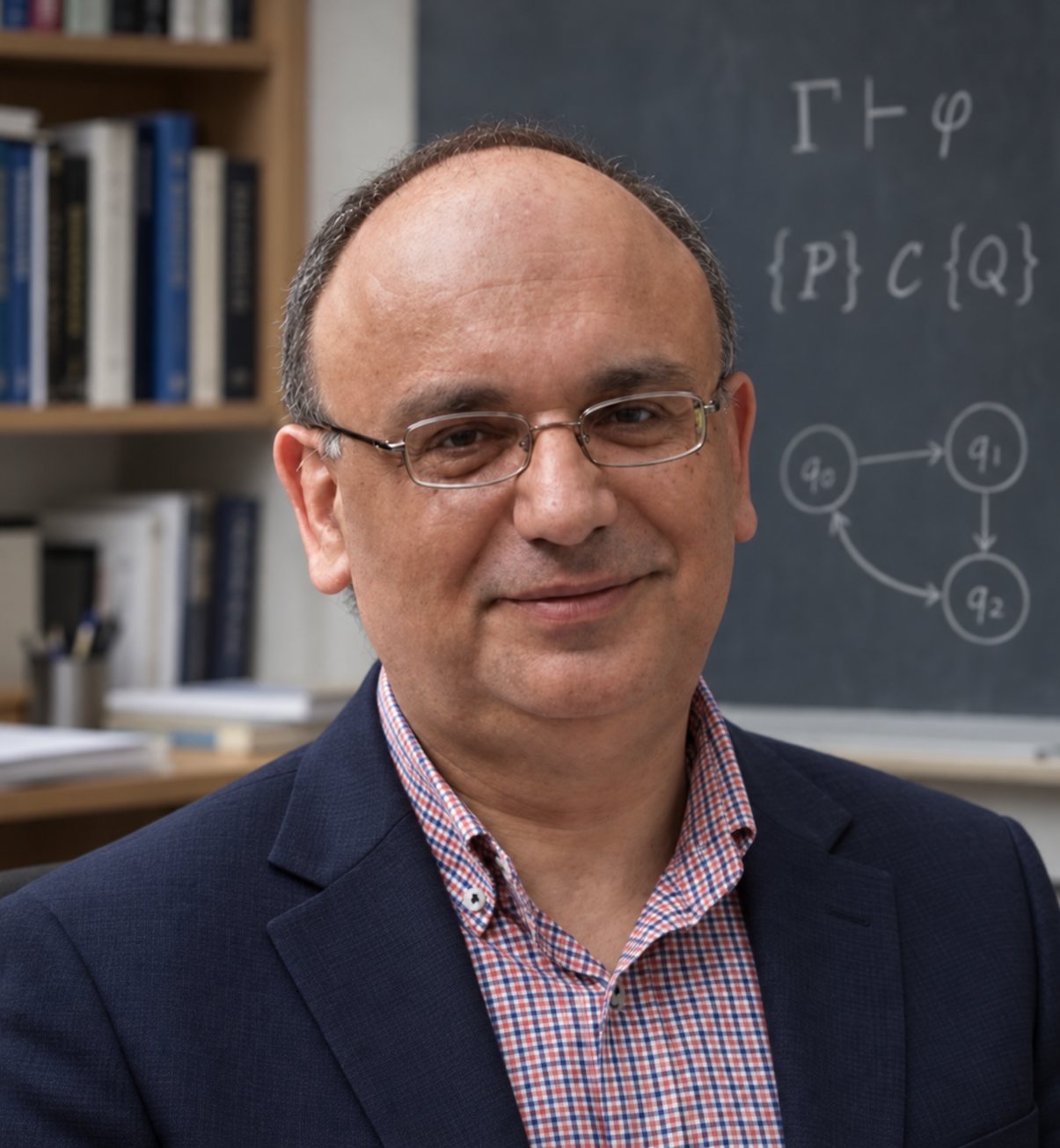
Petros Stefaneas is Professor in the Department of Mathematics at the School of Applied Mathematical and Physical Sciences of the National Technical University of Athens (NTUA), specialising in Logic and Formal Methods in Computer Science. He coordinates the λ-Form research group within the Laboratory of Algorithmic Applications and Logic.
He holds a degree in Mathematics from the University of Athens and a PhD from the National Technical University of Athens, awarded in 2002 for research on the applications of logic in computer science. He also spent several years conducting research at the Mathematical Institute and the Computing Laboratory of the University of Oxford.
His research focuses on mathematical logic, the semantics of programming languages, formal methods, algebraic specifications, and the logical foundations of computational systems. Alongside these technical fields, he investigates the philosophy of computer science, the logic and ethics of artificial intelligence, information ethics, and the philosophical implications of digital technologies.
His work explores how formal logical systems can contribute to the specification, verification, and understanding of computational processes, while also addressing questions concerning the reliability, accountability, and social consequences of intelligent technologies.
As coordinator of the λ-Form research group, he contributes to the study and development of logical and formal methods in computing. He has participated in national and international research collaborations, interdisciplinary networks, and scientific conferences addressing topics such as privacy, information law, and the philosophy of computation.
He teaches undergraduate and postgraduate courses, including Techno-regulation and Data Science, and has served on the NTUA Research Ethics and Deontology Committee. His academic work connects the mathematical foundations of computing with philosophical inquiry into the nature, limitations, and ethical implications of contemporary information technologies. He is a member of the Scientific Council of the Institute of Philosophy and Ideas.